Why do I feel so calm?
The tears: quiet, hot tears flow from my eyes, and yet I feel calm for myself. I worry for people that are dear to me - how will this new knowledge affect them?
How is this new knowledge affecting me? Am I angry? Well, no, not really.Well, maybe yes! Who is ever ready for this?
I am thinking, however, something like this: "Sorry, but please don't tell me that I must look out for myself! Actually, no, I am not sorry, just don't tell me that I have to look out for myself. Just don't go there. Of course, I will look out for myself! But I also have a family, and while I have life and breath, I will look out for them, too."
And don't tell me to stay positive!!! OK?? Of course I will stay positive. I find that this is something akin to laying a new burden on me if someone tells me to stay positive. I feel this way: "What if I don't stay positive, what if I should become afraid, or angry, or negative? Is the cancer going to become worse? Will I be punished because I did not stay positive?"
In the next few days I am going to concentrate on the wonderful question one of my friends asked: "What can I do that will help?" That was such an amazing question! For now I will say that I have found the love and caring that I feel from my friends to be the most helpful. And just think of it! Love and moral support is free to give!
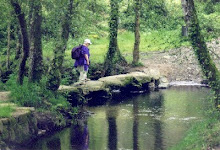
I thank all my friends for that, and look forward to walking this new Camino. Do I welcome it? No. Did I wish for it? No. Did I ask for it? Hell, no! Shall I get under the bed, and hide? Sorry, but that is not on the agenda. This new Camino starts on North Drive, and it becons us to go out and follow.
Later this week I will tell you about another Camino (of sorts) from Jerusalem to Emmaus.
Today we met with amazing doctors at the Grand River Cancer Centre. They were competent and sensitive, mindful of my feelings. They explored with subtle vigilance, seeking to discover how we were taking the news. Would they have to give the information in several doses? Would we be open to hearing the whole story? I appreciated that; it enabled me to state my wish for clarity and openness. They gave me that.
We were blessed to have Dr. John Lockhead accompanying us. John is a talented friend, acquainted with pain, both physical and spiritual, and familiar with the care of the body and the spirit. His presence enabled us to have a third set of ears to hear the information and another mind to absorb and ask questions. "Thank you" seems like such a paltry phrase, John!
I will understand better this coming Friday when I meet with Dr. De Carolis again. Until then, I have received a new prescription to keep the pain under control, and I am comforted by the fact that on a first examination she did not feel bumps or lumps on any glands or on my liver. There will be further tests to determine this for sure, but for now I will start on oral chemotherapy, and pain management. I also have to get a little dental issue taken care of, and then we're off with the chemo and/or radiation.
Will I lose my carefully grown hair, now that it looks wonderful again? Maybe not, but, you know what? Compared with seeing my grand kids, my children and their partners, and my husband, what's a little hair loss if it should come to that?
Off we go, May is the best month to start walking, so I will see you around, with my dilaudid and chemo, on the way to Santiago!
Tuesday, May 15, 2012


Thursday, May 10, 2012
Here We Go Again!
Today is the 10th of May, 2012. Eight or nine months ago I had finished my Radiation therapy, the Chemotherapy time was becoming a memory, and I was getting ready for a lap around the Eastern Mediterranean with my husband David, and my sister and brother in law. My only concern then was staying out of direct sun, and not overdoing things, for I was a bit weak and tired easily.
As my treatment ended eight or nine months ago I felt no great euphoria, but I was generally content. I looked forward to going back to work at St. Mary's Hospital. Life was good: I had a wonderful husband, two really nice children and the smartest, most beautiful grandchildren that you ever could imagine.
In November I went back to work. My return to work made me feel not only that life was good; life was also normal! On the 24th of November we attended a fund-raising dinner in my honour, sponsored by the Kitchener Waterloo Multicultural Centre. What a magical evening it was! I loved seeing so many people, from different parts of my life, enjoying a fine meal and a good time together.
Christmas was a wonderful time. My son John and his partner came to visit from California. We went to Ioanna's house in Ottawa and enjoyed children's games, a beautiful church service, good meals and laughter, lots of laughter.. For the first time I went out in public without my wig -- my hair was finally long enough!
In January we went to the lake and experienced the winter landscapes so typical of the Addington Highlands region. Life was indeed good.
I started getting a pain in my ribs around the 9th of January. At first my doctor thought it was reminiscent of shingles pain. Soon after that, however, it was clear that the pain was concentrated around several ribs. A bone scan and a bone density test showed nothing suspicious, other than three broken ribs.
In January there were pain killers, waiting for the ribs to heal, a fainting spell in the elevator at work, and all kinds of tests as a result of that. I continued to work, still feeling pain, but taking pain killers and waiting for the ribs to heal.
A trip to Cuba in February allowed us to enjoy the warmth and beauty of a beautiful country and of a fun time in the sun and sea. I was still in pain, but felt the ribs were healing. I kept taking my pain killers.
Easter at the lake with my daughter and her family and with David's sister Carolyn, her husband Gord and their son Malcolm. The holy day brought the enticing aromas of Easter cookies and bread, lamb, ham, and the glorious assurance of new life after the dead winter. Resurrection was all around us, and also the delightful news that Malcolm and Suzanne were expecting a child in the summer.
More pain killers, and more waiting for the ribs to heal. My doctor thought it was time for an x-ray. That showed that the ribs were healing. But why the pain? We discussed metastasis. "I will send you for another scan and if it is what we think it is, I will refer you to Grand River".
It was what we thought. The report states that the considerable change between the January and April scans is "consistent with metastasis". This was followed by another referral to Grand River Cancer Centre. My appointment will be on the 15th of May.
Last week was not an easy one. "Here we go again", I thought. I asked myself "How do I tell my son and my daughter?" It is easy to tell good news, but how do you communicate bad news on the phone? You cannot see facial expressions. Even the voice can play tricks through the phone lines. How to interpret silence at the other end? How do I keep my voice even and steady? How do I keep from chattering idle words? Will I be able to sound balanced and calm, or will my voice break?
Finally, I asked myself, "wouldn't my children prefer me to be honest?" My children are grown up and have a trusting relationship with me. This last question helped me to focus on telling my children the truth, without minimizing the issue. I realized that they would want to know as soon as I know, rather than have me manipulating the truth and the timing. Our conversations last Saturday, while serious and sad, were inspiring, loving and encouraging.
My husband reminds me that I never closed my blog last year. I know. Why didn't I? Was I weary of sounding too over confident? Was I waiting for the other boot to fall? Was it just another example of my inability to process goodbyes?
Today I am thinking, here we go again. How do I deal with metastasis? How do I stop doing the job I love? How? Was this supposed to happen? Why do I feel so sad?
Then I ask myself, "Is it time to take to the road again?" Yes! Again we set off on the road to Santiago. We are not there yet. We walk, get tired, fall, get up, walk some more, take a break, get tired, make the wrong turn, come back again to the main road. The Road to Santiago continues to be a metaphor for life. Now more than ever, walking to Santiago is the best metaphor for this life we are living. Thank you David, for reminding me that I did not close my blog last fall! The way to Santiago continues, this time through the land of metastasis. I invite you to come with me, let us go, the road is waiting; the pilgrimage continues.
... and we will see you again, with the pain and a few broken and cracked ribs, with a few tears now and again, with joy and laughter and hope. It is a different kind of hope this time, but we will always be hopeful, always exultant, moving toward a shining goal. We will see you again, on the way to Santiago!
Tuesday, August 23, 2011
For Some Planetary Pilgrims, "Fighting Cancer" is not an Appropriate Metaphor
Some time ago, I wrote about my understanding of spiritual care of persons who have been affected by cancer, either personally or as family members (June 25, 2011). One of my points had been that we often overuse the term "fighting cancer", or "staying positive". This overuse could create a perception that if the patient does not get better it must be because they did not fight hard enough, or because they "lost the battle".
Today's Globe and Mail, August 22, 2011 has published a relevant article, in reference to the death of Jack Layton, Leader of the New Democratic Party and the Leader of the Opposition in the Canadian Parliament.
I have found this article particularly meaningful and useful. It is certainly time to explore our understanding of cancer, and of persons who have cancer. Though many cancer patients see themselves as fighters in a battle, it may well be time for us to consider other metaphors. A look at way that Jack lived the last six months of his life, and a reading of his Lettter to Canadians, demonstrates that, really, he did not "lose" anything. In fact, Jack died of Cancer, and we have lost a great Canadian example, but his spirit soared as he encouraged us to choose love over anger, hope over fear, and optimism over despair,
In the spirit of respect for Jack's example, and in appreciation to the Globe and Mail, I would like to share the article in its entirety:
Jack Layton didn’t lose a fight: He died of cancer
CARLY WEEKS
From Tuesday's Globe and Mail , Published Monday, Aug. 22, 2011 4:56PM EDT
Last updated Tuesday, Aug. 23, 2011 8:20AM EDT
Did Jack Layton die from cancer because he didn’t fight the disease hard enough? Of course not.
Why, then, did so many headlines and social media messages spreading news of his passing Monday morning at age 61 announce that he had lost a battle with cancer?
Even Prime Minister Stephen Harper, in his statement about the opposition leader’s death, noted that Mr. Layton “gave his fight against cancer everything he had,” and that he “never backed down from any fight.”
It’s a common cliché, one many of us use when talking about a disease that is often feared and rarely understood.
But to those touched directly by cancer, equating the illness with a war against the enemy, fighting an adversary, or suffering in order to survive can diminish understanding of the challenges and complexities faced by patients and their families.
“The idea that he was waging a battle which he lost demeans him,” said Robert Buckman, a medical oncologist at Princess Margaret Hospital in Toronto. “I absolutely feel that he did not lose to an adversary.”
Many oncologists and cancer patients have been pushing in recent years for a change in the well-meant, but often misguided words and phrases that have become ingrained in the cancer lexicon.
The outpouring of emotion over Mr. Layton’s death provides an opportunity to ask whether it’s time to move beyond the militaristic metaphors and clichés.
A significant problem is that most of the common words and phrases we use to describe the experiences of people who have been diagnosed with cancer imply that personal will and self-control play a large part in determining who will live or die.
To say Mr. Layton lost his fight implies he had a say over his fate.
“He didn’t choose any of that any more than I could have chosen the colour of my eyes: It’s that arbitrary,” Dr. Buckman said. “It’s a much more mature and helpful comment to say this man, faced with a rotten hand of cards, as it were, really gave meaning to his life and to what he did in his life.”
London-based writer Mike Marqusee, who has discussed his experiences with multiple myeloma in several pieces in The Guardian, says cancer has little to do with battle. “The [emphasis] on cancer patients’ ‘bravery’ and ‘courage’ implies that if you can’t ‘conquer’ your cancer, there’s something wrong with you, some weakness or flaw,” Mr. Marqusee wrote in 2009. “If your cancer progresses rapidly, is it your fault? Does it reflect some failure of willpower?”
Similarly, saying someone who is now cancer-free is a “survivor” conveys that he or she is somehow better than the people who didn’t make it, said Peter Ellis, staff medical oncologist at the Juravinski Cancer Centre in Hamilton, Ont.
“It does set up a battle with a winner and a loser, and I think that some people certainly think that there would be better ways of talking about this,” said Dr. Ellis, who is also an associate professor in the department of oncology at McMaster University.
Instead of fixating on the idea of a cancer battle, Dr. Ellis and a growing number of experts in the field say, it is more important to focus on learning to live with cancer.
For those undergoing treatment, this can be much more empowering than the idea they can somehow control the ultimate outcome if they fight hard enough.
It is the attitude that gets Barb Rowe-Bennett through each day. The 64-year-old Toronto resident, who has had cancer off and on for nearly 20 years, is in the last stages of palliative care after her breast cancer metastasized, or spread, to her bones and lungs.The medication she is taking keeps her comfortable and enables her to leave the house, spend time with family and enjoy each day as it comes.
Ms. Rowe-Bennett doesn’t see herself as a “survivor” even though she has managed to outlast the cancer thus far; nor does she feel she has been cursed by bad luck because the disease is still with her.
“I just feel that cancer is an interference in your life, and you have a choice of making it good or bad,” she said. “You can bring yourself down, and it can be the worst of the worst, or you can say ‘I can carry on, I will deal with [it] on a daily basis.’ ”
......................
Thanks for reading the article. This is not to say that having cancer is not a devastating struggle; it is! But it is also something over which we do not have so much control. Winning and losing, in this context, can be quite irrelevant. Much more important to explore how we can soar, rise above it, and value the example of life well lived. Listen to Jack's last words to us: "My friends, love is better than anger. Hope is better than fear. Optimism is better than despair. So let us be loving, hopeful and optimistic. And we’ll change the world."
On my part, I continue my pilgrimage. And we will see you around, exploring the use of language, sometimes fighting and struggling, but above all living this pilgrimage of ours, until we get to Santiago.
Thursday, August 11, 2011
Planetary Pilgrims Are Mindful of Diverse Traditions
Many of my friends are Muslim. This month, Ramadan, is a special and challenging time for them, during which their world is turned upside down! Night turns into day, and mealtimes are reversed. During daylight hours our Muslim brothers and sisters neither eat nor drink, not do they indulge in other pleasures.
This is a good way to explore the life of the poor and the hungry, and to learn how much we take for granted. It is also done as celebration of the Revelation that the Prophet Muhammad received. One particular chapter from the Qur'an is appropriate to our own family celebrations today: Sura 93. It has always reminded me that God has often found us in need and has supplied more than we expected. "Therefore ... of the Bounty of your Lord be your discourse"!
Look it up, Google has many different interpretations of Sura 93. I am most partial to Pickthall, because it was the one I first saw, when I was a young girl.
Indeed, today I am thinking about the bounty of God and thanking God for the bounty of friends from every tradition who have been walking this journey with us. And we shall continue, walking and thanking, on the Way to Santiago.
Wednesday, August 10, 2011
This Planetary Pilgrim is Celebrating
Today I had what we all hope was my eighth and last chemotherapy session! This is a good reason to celebrate, and we are celebrating, albeit quietly. We did not go out to eat, nor did I get picked up from the hospital in a limo by a chauffeur wearing a classy uniform. There were no fancy wines, no prime rib roast , no exotic cheese tray with fancy crackers, no Pavlova dessert followed by a wee bit of cognac on the terrace. Yet, we celebrated nonetheless; and who knows, tomorrow morning we might go to the City Cafe for a gourmet bagel and fair trade coffee!
We (David, Ioanna, Gracie and I) are processing the day and its meanings, at home, quietly.
Gracie, age six, asked her mother how we get cancer. You know, there are ways of talking with young children about cancer. Her uncle Josh had leukemia and lived. Another close family member had breast cancer and lived. And now, her grandmother has finished chemo..
Two days ago Gracie came with us to Grand River Hospital, and saw the lab technician getting blood samples. It did not hurt. She was there when they sent the vials up to the main lab, zap!!! through the shoot.
Today Gracie met my nurse Debbie, who spoke with her briefly about having met both Gracie's mother and her uncle on earlier occasions. They talked about Gracie's trip to California last year, and her trip to Puerto Rico 2 weeks ago.
All this conversation happened while Debbie, R.N. was setting up the injection site. After a brief while Gracie went to the waiting room, to do her work. She played a word spelling tile game with her mother. She created a thank you drawing for Debbie, R.N., and another one "for the whole hospital" as she told me. This work of art now hangs on the wall behind the nursing desk in the chemo suite.
Children are all different. They need frank and open answers, and these answers vary depending on the family and on their own sense of security. In our family, our children have been a part of the process from the beginning. However, children do not need to be exposed to every episode. They need simple, truthful, matter-of-fact, loving answers, and then children move on to their work, which is play.
So, Gracie was not present when the R.N. had to keep struggling to set up the injection site. My veins have become very flat and challenged. It took six tries, and three nurses (two of them vein specialists) to finally get a connection. It was not fun, but I was proud of myself. It is a good thing that this was the last chemo session. The veins on my one available arm seem to have become compromised. Any future chemo might need other solutions.
So how do I feel? Quiet. Amazed. Full of wonder and awe. Above all, I feel grateful. Let me use the language of my forebears: we are told by St. Paul to "Rejoice in the Lord always, and again I say Rejoice." Well, I am rejoicing, again and again!
Sure, days three to eight might get a bit nasty. Pain is likely to affect me, and dullness in my hands and legs may require medication that will make me feel like a zombie. My eyelashes might yet fall out. Yet my family and I have gone through a rather brutal challenge and come out feeling triumphant and joyful. What more do we need to say?
And we will surely see one another again, always rejoicing, on the way to Santiago.
Breast Cancer Screening - Public Information - MOHLTC
It is good to live in Ontario, where the Ministry of Health and Long Term Care recently extended the Breast Screening Service to serve more people.
Please consider doing something for yourself in this regard. I invite you to visit:
Tuesday, August 9, 2011
Planetary Pilgrims Know When to Take a Little Time Off
It may be that the effect of chemo is cumulative. I have felt worse during this cycle. It has taken me longer to spring back, and the "spring" in my step is certainly not so bouncy!
The numbness in my hands and feet has been noticeable. Although there has not been loss of function, I do find it difficult to type, and I am a bit wobbly on my feet, losing my balance from time to time.
The depression that I normally feel on days three to eight has not been so overwhelming. I would characterize it more as a loss of "time orientation". Even though I knew that the sensation of despair would end by day eight, I found it hard to tolerate the waiting. David has been great at seeing me through this time, and so have my children.
My appetite has been really bad. Even though I know intellectually that it is important to eat and drink regularly, I have found it hard to do. Food tastes different. Let's be frank: food tastes bad!
And water is either too salty or too sweet. Ioanna concocted a great drink for me that I have found quite good: a combination made of water, orange juice, lots of ice and a handful of blueberries. I discovered that her sangria also tastes pretty good, and so does clamato juice.
What has helped? Lots of phone calls and e-mail messages, going out for a meal even if I can't finish it, going to the cottage, reading Rumpole of the Bailey stories. And being lazy - letting other people do things for me, though this is harder than you think.
David had a birthday during this two-week cycle. We had two days of parties at the lake. It was quieter and more sedate than usual, not out of deference to age, but because I could not do much myself. David's sister Carolyn was a wonderful hostess, and my daughter Ioanna did a lot of the work. My thanks to them for keeping up the outrageous birthday traditions.
Tomorrow I will have what we all hope will be the last chemo session. Can you hear the Alleluias? The doctor has reduced tomorrow's taxol dose by 15% because of the numbness in my legs and hands. Still, it will be close to a five-hour experience. My daughter Ioanna and grand daughter Gracie will be with me. I am ready. I have charged my mp3 player, and have my Kindle all charged up also. We shall survive it.
To what shall I compare tomorrow's experience in my journey? I will think this, and write again soon, if my fingers allow. In the meantime, let us sit here for a bit, and enjoy the view, while getting ready to continue the journey tomorrow. And we will see you around soon, on the way to Santiago!
Subscribe to:
Posts (Atom)